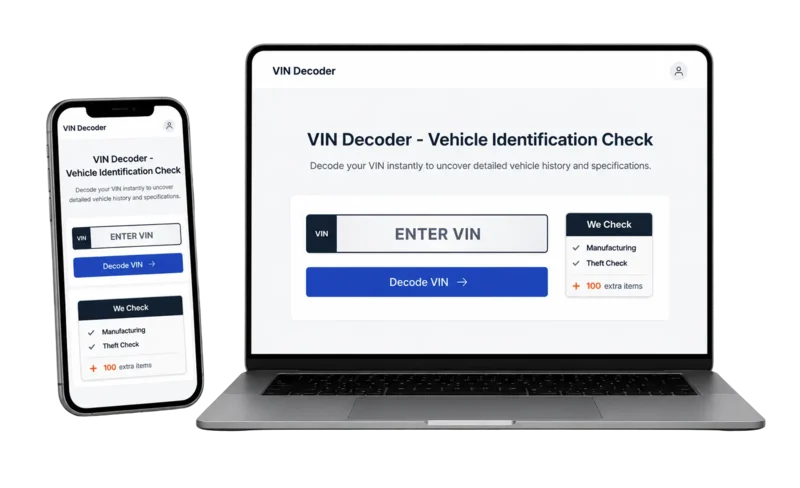
VIN DecoderVehicle Identification Check
Decode your VIN instantly to uncover detailed vehicle history and specifications.
VIN Decoder - Vehicle Identification Check
Decode your VIN instantly to uncover detailed vehicle history and specifications.
We Check
- Vehicle Specs
- Engine Details
- Manufacturing
- Safety Features
- Theft Check
-
100 extra items
How to decode a VIN ?
Using our VIN decoder takes under 30 seconds and requires no sign-up:
-
1
Locate your VIN on the V5C logbook or the vehicle itself (see the locations section below).
-
2
Enter all 17 characters into the decoder above, with no spaces or hyphens.
-
3
Click ‘Decode VIN’ and you’ll instantly see the vehicle’s make, model, model year, engine family, body style, country of assembly and factory equipment where available.
The basic decode is entirely free. If you need an outstanding-finance check, write-off status, theft markers or a full keeper history, you can upgrade to a premium UK vehicle history report.
What is a VIN and how is it structured?
The Vehicle Identification Number (VIN) is a 17-character alphanumeric code assigned to every vehicle at the point of manufacture. The format was standardised internationally under ISO 3779 (first published in 1977), with the US NHTSA (National Highway Traffic Safety Administration) mandating the 17-character VIN for all vehicles sold in the US from 1981 onwards. The same format is now used in over 80 countries including the UK.
No two vehicles ever share the same VIN. This code is the primary key used for DVLA registration, insurance, manufacturer recalls, servicing records and resale. The letters I, O and Q are always excluded from a VIN to prevent confusion with the digits 1 and 0.
The three segments of a VIN: WMI, VDS, VIS
A VIN breaks down into three blocks that together reveal origin, configuration and the vehicle’s individual identity:
WMI
Pos. 1 – 3World Manufacturer Identifier: country of manufacture and carmaker
Example: SAL = Land Rover (UK)
VDS
Pos. 4 – 9Vehicle Descriptor Section: body style, engine, model line
The 9th character is often the check digit. Example: LFA2A8 = Defender, 2.0 diesel
VIS
Pos. 10 – 17Vehicle Identifier Section: model year (pos. 10), assembly plant (pos. 11), serial number (pos. 12-17)
Example: M = 2021, Solihull plant
WMI country codes — reference table
The first three characters of a VIN identify the manufacturing region and carmaker. Here are the main WMI ranges relevant to UK buyers:
| WMI range | Region | Common examples (UK-relevant) |
|---|---|---|
| SA – SM | United Kingdom | SAL = Land Rover / Range Rover, SAJ = Jaguar, SCC = Lotus, SCE = DeLorean, SHS = Honda UK |
| W, WB, WD, WV, WP, WU | Germany | WVW / WV1 = Volkswagen, WAU / WA1 = Audi, WBA / WBS = BMW, WDB / WDD = Mercedes-Benz, WP0 = Porsche |
| VF | France | VF1 = Renault, VF3 = Peugeot, VF7 = Citroën |
| ZFA – ZFF | Italy | ZFA = Fiat, ZFF = Ferrari, ZLA = Lancia, ZAR = Alfa Romeo |
| J | Japan | JHM = Honda, JTD = Toyota, JN1 = Nissan, JMZ = Mazda |
| KL – KR | South Korea | KMH = Hyundai, KNA = Kia |
| 1, 4, 5 | United States | 1FA / 1FT = Ford USA, 1G = GM |
| 2 | Canada | 2T1 = Toyota Canada |
| 3 | Mexico | 3VW = Volkswagen Mexico, 3FA = Ford Mexico |
A UK-built Range Rover will typically begin with SAL; a Wolfsburg-assembled Golf with WVW; a French-built Peugeot with VF3. If the WMI doesn't match the badge on the car, that's a red flag worth investigating further.
Where to find the VIN on your car and your V5C
In the UK, the VIN appears on your V5C registration certificate (the logbook) in the Vehicle Details section. This 17-character string must be identical to the number physically stamped and displayed on the vehicle itself.
On the car, the VIN can be viewed at several locations:
| Location | What to look for |
|---|---|
| Base of the windscreen | Driver's side, visible through the glass on a small metal plate attached to the dashboard |
| B-pillar / driver's door frame | Manufacturer's sticker (often includes tyre pressures and max weights) |
| Under the bonnet | Riveted manufacturer plate on the slam panel, firewall or suspension tower |
| Chassis / floor | Cold-stamped into a longitudinal chassis rail or under the rear seat/spare wheel well |
| Documents | V5C logbook (Vehicle Details section), insurance certificate, service book, purchase invoice |
Always cross-check that the VIN on the V5C, on the windscreen plate, and on the manufacturer's plate under the bonnet are identical. Any difference — including a single character — is a red flag for VIN cloning, especially on a used car purchase.
Worked example
Take the VIN WVWZZZ1KZ9W123456. The decoder reads: WVW = Volkswagen (Wolfsburg/Germany passenger cars), ZZZ = fillers used by VW, 1KZ = Golf Mk6 5-door, Z = check digit, 9 = model year 2009, W = Wolfsburg plant, 123456 = serial number. Once you've located your VIN on the V5C or windscreen plate, run it through the decoder above to check the seller's advert holds up.
Checking a used car in the UK: beyond the VIN decoder
A VIN decoder confirms what a car is. To confirm its its history, combine it with the official UK services:
MOT history check
Free · Gov.ukThe UK government runs a free MOT history service at gov.uk/check-mot-history. Enter the registration plate and you'll see every MOT test result, mileage at each test, advisories issued and reasons for failure. This is the single most powerful free due-diligence tool available to UK buyers and reveals mileage discrepancies instantly.
HPI check
Premium historyAn HPI check is the UK-standard commercial vehicle history check. Alongside the core VIN data it covers outstanding finance agreements, insurance write-off markers (Categories A, B, S, N), stolen-vehicle alerts, keeper history, number-plate changes and import status. Alternatives include AA Car History, RAC Vehicle Check and carVertical UK, all using similar data sources.
DVLA vehicle enquiry
Free · DVLAThe DVLA vehicle enquiry service at gov.uk/get-vehicle-information-from-dvla returns free basics: tax status, SORN status, MOT expiry, CO₂ emissions, revenue weight, date of first registration and colour. Combine this with the VIN decoder to build a complete picture before viewing a car.
UK write-off categories explained: A, B, S, N
When an insurance company declares a vehicle uneconomical to repair, they assign it one of four categories under the ABI (Association of British Insurers) framework. These markers are recorded on industry databases and surface in a full HPI-style check. The VIN is the anchor that ties a vehicle to its write-off history.
| Category | Status | What it means |
|---|---|---|
| Cat A | Scrap only | Severely damaged vehicle that must be crushed. No parts may be reused. Never re-enters the road. |
| Cat B | Body shell destroyed | Damage so extensive that the body shell must be crushed. Some parts may be salvaged and reused in other vehicles. |
| Cat S | Structural damage | Previously "Cat C". Structural damage (chassis, subframe, crumple zones) that has been or can be repaired. Safe to drive once properly restored. Must be re-registered. |
| Cat N | Non-structural damage | Previously "Cat D". Non-structural damage (electrical, cosmetic, panels). Can be repaired and driven legally, usually at a lower resale value. |
Cat S and Cat N vehicles can be perfectly safe once properly repaired, but they typically sell for 20–40% less than an equivalent clean-history car. Always ask a seller to disclose write-off status in writing, and verify via HPI or equivalent — a free VIN decoder alone won't flag this information.
Free VIN decoder vs HPI check: what’s the difference?
A free VIN decoder and a paid HPI-style check serve different purposes. Here’s what each one tells you:
| Data point | Free VIN decoder | HPI / premium check |
|---|---|---|
| Make, model, year, engine | Yes | Yes |
| Country of assembly / plant | Yes | Yes |
| Factory equipment / options | Partial | Yes |
| MOT history | No (use Gov.uk) | Yes |
| Outstanding finance | No | Yes |
| Write-off category (A/B/S/N) | No | Yes |
| Stolen marker (police/insurance) | No | Yes |
| Mileage discrepancies | No | Yes |
| Previous keepers | No | Yes |
| Import / export history | No | Yes |
| Cost | Free | £15 – £20 per check |
For a quick ID check before arranging a viewing, the free VIN decoder is enough. Before actually handing over money on a used car, pair it with the free Gov.uk MOT history check and a full HPI (or equivalent) report. That combination costs under £20 and catches the vast majority of hidden issues.
Spotting VIN fraud and cloning
VIN cloning is the practice of attaching the VIN of a legitimate vehicle to a stolen or written-off one of the same make, model and colour. If you buy a cloned car, the DVLA or police can legally seize it and you lose your money. Protect yourself before buying with these checks:
Cross-check the three VIN locations
V5C, windscreen plate and bonnet plate must be strictly identical — not just similar.
Match the VIN to the make, model and year
Our decoder shows this in seconds. A Ford badge on a car with a WVW VIN is impossible — that's a cloned or swapped shell.
Run a full HPI check
Stolen markers, salvage status, outstanding finance and mileage anomalies only surface here.
Inspect the plates physically
The manufacturer’s plate under the bonnet should be held by factory rivets (round, flush, paint-matched to the body). Pop rivets, screws, fresh paint around the plate, or visible re-stamping on the chassis are serious warning signs of a swapped identity.
Verify the 9th character (check digit)
Our decoder validates the ISO 3779 check digit automatically. A mathematically invalid VIN is either a typo — or fake.
If anything feels off, walk away
Report suspected VIN cloning to Action Fraud — now rebranded as Report Fraud (actionfraud.police.uk / reportfraud.police.uk, 0300 123 2040) — and to the DVLA.
Decoding a VIN by make: BMW, Mercedes, Audi, Peugeot, Porsche, Tesla, Kia, Alfa Romeo, Renault, Jaguar & Opel
Each manufacturer uses the VIN slightly differently. Our tool auto-detects the make from the WMI and applies the correct lookup tables. Here are the essentials for the most-searched brands in the UK:
BMW VIN decoder
WBA · WBS · WBY · 4US · 5UXBMW VINs typically start with WBA (saloons/estates), WBS (M cars), WBY (i-series, EVs) or 4US/5UX (US-built X models). Position 10 gives the model year; positions 4–7 encode the body line (E46, E90, F30, G20…). Full options are best cross-checked on the official BMW online vehicle history portal with the VIN.
Mercedes-Benz VIN decoder
WDB · WDC · WDD · WDF · WMXClassic Mercedes WMIs are WDB (saloons/Maybach), WDC (SUVs), WDD (compact/CLA/GLA), WDF (vans/Sprinter) and WMX (AMG sports cars). Since 2022 new cars use W1K (cars) and W1N (SUVs). The VDS encodes body class (e.g. 204 = previous C-Class) and engine family.
Audi VIN decoder
WAU · WA1 · TRU · WUAAudi VINs include WAU (saloons/hatches — A3, A4, A6), WA1 (SUVs — Q3, Q5, Q7), TRU (Audi Hungary — TT, some A3) and WUA (Audi Sport — RS, R8). Audi shares the PR-code system with VW — useful for confirming factory options.
Peugeot VIN decoder
VF3 · VR3 · 8AD · LDCPeugeot WMIs are VF3 (passenger cars, France), VR3 (post-2020 Stellantis models), 8AD (Argentina) and LDC (Dongfeng, China). Positions 4–8 encode the range (208, 308, 3008, 5008), body type and powertrain — PureTech petrol, BlueHDi diesel or e-/HYBRID. The 11th character identifies the plant (Sochaux, Mulhouse, Poissy, Vigo).
Porsche VIN decoder
WP0 · WP1 · WP2Porsche WMIs are WP0 (911, 718, classic sports cars built in Zuffenhausen), WP1 (Cayenne, ICE Macan, built in Leipzig) and WP2 (Panamera, Taycan, Macan Electric). Positions 4–8 encode model, body style and engine family — flat-six, flat-four, V8 or electric J1. European VINs often show ZZZ in positions 4–6; full options require a Porsche Centre datacard lookup.
Tesla VIN decoder
5YJ · 7SA · LRW · XP7 · 7G2Tesla ties the WMI to the Gigafactory: 5YJ (Fremont, USA), LRW (Shanghai), XP7 (Berlin) or 7SA (Austin, Texas). Positions 4–8 encode model line, propulsion (RWD, AWD, Performance) and often battery chemistry (LFP, NMC, 4680). Position 10 gives model year — critical when comparing used Model 3/Y packs and range.
Find a registration from a VIN (and vice versa)
DVLA records hold the link between every UK vehicle's VIN and its registration number, but the public DVLA enquiry tool only accepts the reg, not the VIN. To go from VIN to reg, you'll need a commercial vehicle history report (HPI, AA Car History, RAC Vehicle Check or carVertical UK). To go from reg to full VIN, the DVLA does not expose it for data-protection reasons — but a paid history report will return it, or you can apply to the DVLA directly using form V888 (£2.50–£5) if you have a reasonable cause such as an accident claim, insurance dispute or property damage.
For a UK-registered vehicle whose V5C logbook is missing, you can request a replacement V5C from the DVLA using form V62 (£25 fee). For a vehicle with no UK registration history at all (imports, project cars built from parts), separate DVLA procedures apply — a V62 alone is not sufficient.
Decoding a motorcycle VIN
Motorcycles built from 1981 onwards use the same 17-character VIN format as cars, under ISO 3779. On a bike, the VIN is stamped on the headstock (right-hand side of the frame under the handlebars), on the swingarm, or on a riveted plate visible without disassembly.
Our decoder supports all major brands: Honda (JH2), Yamaha (JYA), Kawasaki (JKA), Suzuki (JS1), BMW Motorrad (WB1, WB3, WB4), Ducati (ZDM), KTM (VBK), Triumph (SMT) and Harley-Davidson (1HD).
One caveat: some older Japanese-market bikes (pre-1990, domestic-only) used a shorter frame number that isn’t ISO 3779-compliant. Standard decoders can’t read these — you’ll need a marque-specialist registry.
Why use our VIN decoder?
Whether you’re buying a used car, checking an online advert, or sourcing spare parts, our free VIN decoder delivers:
Instant results with check-digit validation
Full specification back in under 3 seconds, with ISO 3779 check-digit maths verified on every VIN — so a fake or mistyped number is flagged immediately.
UK-first design
Built around the V5C logbook, DVLA data and UK-specific write-off categories — not a rebadged US tool.
All makes, all years (post-1981)
BMW, Volkswagen, Audi, Ford, Mercedes, Toyota, Vauxhall, Nissan, Kia, Land Rover and every other major brand sold in the UK.
Cars, vans and bikes
Our database covers passenger cars, light commercial vehicles and motorcycles, updated regularly from manufacturer feeds.
Recently decoded VINs
Demonstrative lookups — illustrative examples similar to searches by our visitors.
| VIN | Vehicle | Country | When |
|---|---|---|---|
WVWZZZ3****456789
|
Volkswagen
|
🇩🇪 | 2 min ago |
1HGBH41****109186
|
Honda
|
🇺🇸 | 5 min ago |
WBA3A5G****P26082
|
BMW
|
🇩🇪 | 8 min ago |
5YJSA1D****P14705
|
Tesla
|
🇺🇸 | 12 min ago |
WDBRF61****654321
|
Mercedes-Benz
|
🇩🇪 | 15 min ago |
TMBJB7N****123456
|
Škoda
|
🇨🇿 | 18 min ago |
VF1RFB0****789012
|
Renault
|
🇫🇷 | 22 min ago |
SALVA2B****012345
|
Land Rover
|
🇬🇧 | 33 min ago |
What’s included in the VIN report?
Get a complete overview of your vehicle with detailed information across all key categories.
General Car Information
- – Brand
- – Model
- – Colour
- – Year of manufacture
- – Gearbox
Fuel & Engine Consumption
- – Power
- – Torque
- – Engine capacity
- – Cylinders
- + 4 more
NCT History
- – NCT expiry date
- – NCT pass rate
- – Failed NCT tests
- – NCT results
- – NCT advice, notice, fail, minor
Damage Report
- – Damage registration
- – Repair costs
- – Date of damage
- – Damage position
Owner History
- – Total registrations
- – Number of previous owners
- – Average days owned
- – Plate changes
Dimensions & Weight
- – Width
- – Height
- – Length
- – Wheel base
- – Kerb weight
Advertisement History
- – Online advertisements
- – Asking price
- – Pictures
Mileage Registration
- – Number of mileage checks
- – Mileage
- – Date of registration
FAQ: VIN decoder
Everything you need to know about decoding your vehicle identification number.
Yes, our basic VIN decode is completely free and requires no account. You instantly get make, model, year, engine family, country of assembly and body style. For outstanding finance, write-off status, stolen markers or full keeper history, you’ll need a paid UK vehicle history report such as HPI.
On the V5C logbook (Vehicle Details section) and physically on the car. See the dedicated sections above for the five main locations.
Exactly 17 alphanumeric characters — the international standard since 1981 under ISO 3779.
A VIN decoder returns the vehicle’s specification (what it is); an HPI check returns its history (finance, write-offs, theft, mileage, keepers). See the comparison table above for a full side-by-side breakdown.
Not on its own. A free VIN decoder only reads the VIN itself, not the insurance databases. To check write-off status (Cat A/B/S/N), you need a full UK vehicle history report such as HPI, AA Car History, RAC Vehicle Check or carVertical, which query the Motor Insurers’ Anti-Fraud & Theft Register.
The 9th character of the VIN is a check digit calculated from the other 16 characters under ISO 3779. Our decoder validates this automatically. You should also cross-check that the VIN on the V5C, on the windscreen plate and on the bonnet’s manufacturer plate are strictly identical — any difference suggests tampering or cloning.
MOT history is free at gov.uk/check-mot-history. Enter the number plate and you’ll see every past MOT result, mileage at test, advisories and failure reasons. Pair this with a VIN decode before buying any used car — it’s the single best free due-diligence tool in the UK.
No. The DVLA’s free vehicle enquiry service (gov.uk/get-vehicle-information-from-dvla) only accepts the registration number (number plate), not the VIN. To decode a VIN itself, you need a third-party tool like ours. The DVLA holds the VIN in its records but does not expose it through a public lookup form, for data-protection reasons.
Not through a free public service. The DVLA does not publish full VINs via its online enquiry tool to prevent identity fraud. You have three options: (1) a paid HPI-style report which returns the VIN alongside the history; (2) the V5C logbook from the seller; or (3) a DVLA V888 form if you have a reasonable cause such as an accident claim, insurance dispute or property damage.